The Bounce Box. Options and alternatives.

Trip update: I spent this week in Georgetown, Texas, still with my cousins. I am happy to report that I was able to complete and deliver the book translation in time to be able to run errands and prepare to leave. This morning, I hit the road again, riding to San Antonio for the ATA Conference (http://www.atanet.org/conf/2013/).

2013-10-28 15.04.38

Working on a book translation in Georgetown, Texas.

This week I would like to discuss bounce boxes. The bounce box is a sturdy box that can be relabeled and reused.

Let me first say that I am indebted to my friend Heather Warren for introducing me to the Bounce Box. Heather has hiked the Appalachian Trail (http://www.appalachiantrail.org/), which I consider a remarkable feat. The “AT” hikers make extensive use of the bounce box, because backpackers can only haul about five to ten days of stuff, and the AT takes much longer than that. They mail ahead the rest of their supplies to “General Delivery” at the next Post Office along the Trail, where they will restock and reorganize.  Continue reading
Getting ready for the Southern Swing 2013

Now that I am on the road and actually doing this, let’s discuss what I did to get ready.

But first a trip update: This week I have been visiting my cousins in Georgetown, Texas. I am using the desk that my cousin uses when she is not commuting to her office in Round Rock. I have been working on a book that turned out to have 40% more material to translate than the publisher contracted for. Without the riding every day, I can put in extra hours and catch up, so that by next week when I leave, the book will be delivered. Had I been on the road, I would have been forced to stop for a while to put in these hours. My budget includes staying in a hotel room when this sort of crisis happens, but being able to fix a meal in the kitchen and do my laundry in a washing machine while I am working is much better.

As for getting ready for the Southern Swing, I had two major areas of preparation:

  1. Preparing myself and the bicycle.
  2. Organizing the office and its support systems. Continue reading

Lessons learned: the Climate Ride 2012.

Trip update: the Conference in Atlanta last Saturday (28 September) was very successful. I strengthened some old friendships and made many new friends. Networking is such an important part of Conference attendance that even without the presentations, the Conferences are usually worth the cost. It helped my mood that the attendees seemed to enjoy my contribution, a presentation on how to set your price and economic decision-making for freelancers.

The riding around Roswell and Atlanta was exciting, partly because Google Maps kept trying to detour me through neighborhoods and bike trails, when I could see where I needed to go on the map. I was glad that I rode into Atlanta on Friday before the Conference, because I was ready to take a more direct route on Sunday when I had to go to the bus station. The bus rides to Georgia and to Texas allowed me to pick up the bicycle-borne part of my itinerary where I would have been had I been able to start in Chicago in late July as originally scheduled. I am writing to you this week from Keller, Texas, where I will spend some time with family – and working on a pair of translations – before heading south to the Austin area.

For the next three posts, I would like to take some space to discuss the lessons learned from the two major rides that I completed, preparing for this Southern Swing 2013: the Climate Ride 2012 and what I call the Giro della Nuova Inghilterra (GNI), which means the Tour of New England. Continue reading

On the road again — at last.

The home renovation which had already slipped six weeks when I launched this blog is now running more than two months behind. Two days ago, I finally packed up my bicycle and rode to the bus station, leaving Daniel, my son and the resident homeowner, in charge of finishing the renovation. Those who are following my bicycle ride on Facebook already have access to the photo story of our renovation. The house is coming together nicely, but I wish I could have seen it completed before I left. Continue reading

The Bicycle, then and now.

First of all, a big thank you to Shai and the others who answered my call for help with image files. Although I have not succeeded in fooling Windows into accepting my old CD dictionary, at least I understand the language now (important for a translator, don’t you think?). Next, I will be looking for backward compatibility issues or an updated electronic Devoto-Oli or comparable dictionary. Now back to the subject:

My friend Heather Warren once she asked me if I had ridden the Blue Ridge Parkway or the Skyline Drive. My answer opens a window to my bicycling soul: Continue reading

How my lives on the bicycle and translating gently merged.

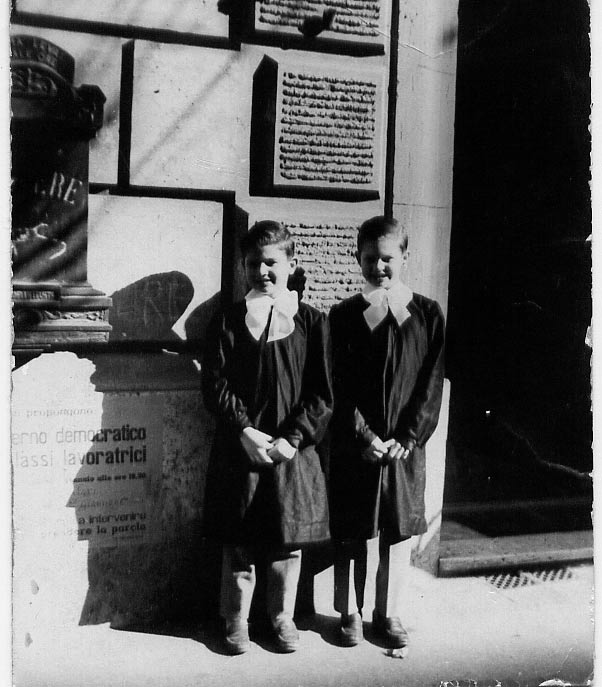
I have been translating since I was 11, riding my bicycle since I was five. They have always coexisted with whatever I was doing. The bicycle would get me around locally. Translating and interpreting (scholars call it language mediation) have been part of my daily work or schooling, or a second job, all my life. It was

The author (R) and his brother David about to walk to school in Rome, 1956.

The author (R) and his brother David about to walk to school in Rome, 1956.

no coincidence that I was an interpreter and a tour guide growing up in Rome, Italy, or that I majored in Italian area studies at the Naval Academy. Continue reading

Welcome to the Freewheeling Freelancer

Why, who, what, and where:

The stated purpose of this blog is to share my experiences riding my bicycle indefinitely while continuing to work and conducting an otherwise normal life. The point is not the bicycle, but the word “indefinitely.” Together, you and I will explore how a freelancer could truly live on the road. Only backpackers have greater issues of time, distance, weight, and logistic support than bicyclists. A freelancer in an RV (caravan), a boat or a car could easily apply the lessons here, perhaps with more slack about what to take and less stress about what to leave behind. Continue reading