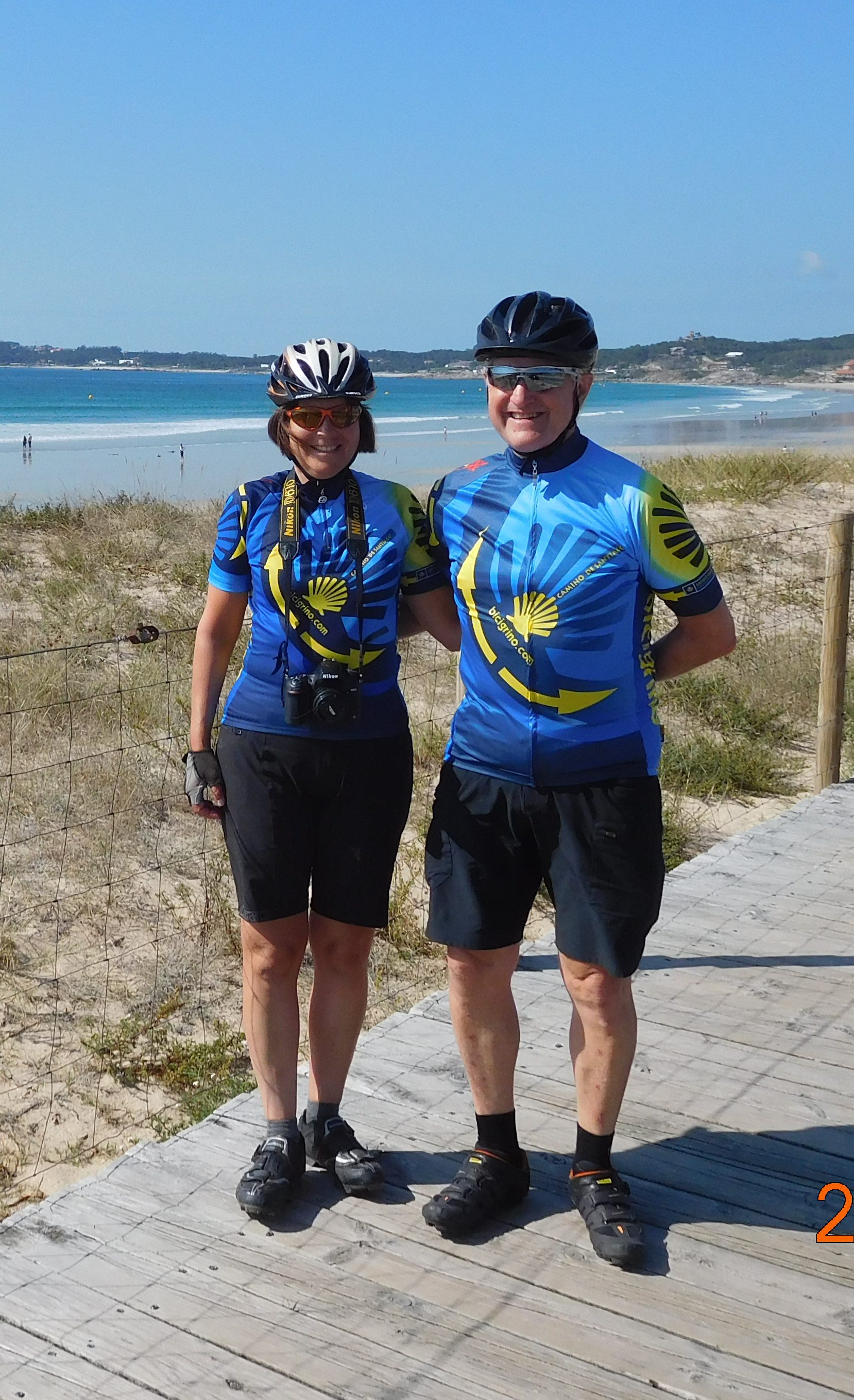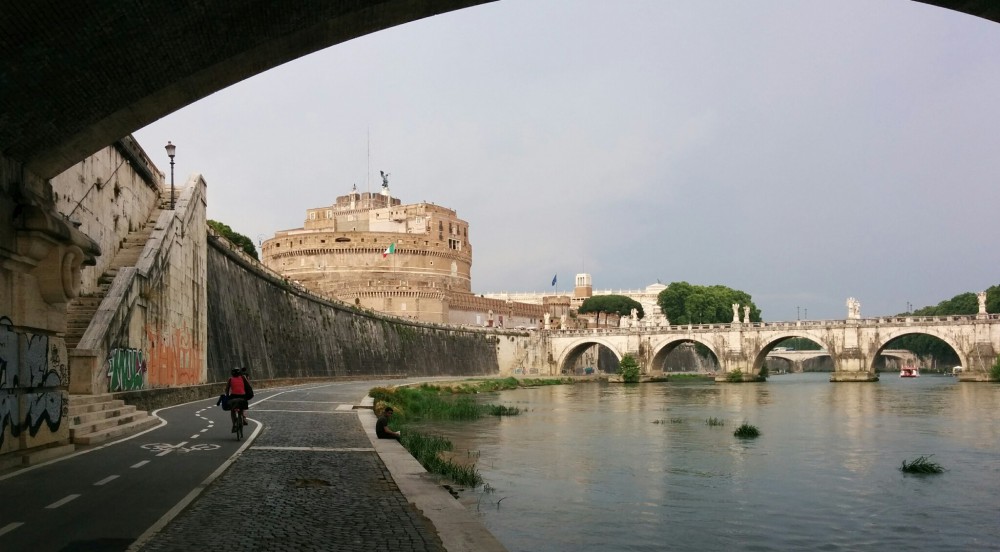
2024 Isole Grandi: Via Allier, Ardèche, and Côtes du Rhône

Monday, 10 June 2024. The light rain that started as Cheryl and I rode to the Lyon Part-Dieu train station grew to a violent thunderstorm as we watched out the windows of the regional train to Clermont-Ferrand. In Vichy on the other side of the front, the sky was clear and sunny, but the air was still cool. Crossing town, we found the paved Véloroute 70 easily, and followed it to the town of Pont-du-Chateau, which was as close to a major city (Clermont-Ferrand) as we would come that week.

Camping Les Sablons was officially open, but only barely. Only a handful of camper vans occupied by contract workers shared the mosquito-ridden property with us. The facilities were in a poor state, and it seemed to me that they did not intend to be ready for the tourist season at all.

On the other hand, Vic-Le-Comte, where we stayed the next day, was a delightful little town. With a population of only 5,000, it was big enough to offer choices of pastry shops, boulangeries, and supermarkets, but small enough to be quiet at night and easily walkable.

The pleasant weather held along the river on the morning of the 12th, but the sky began to darken. By the time we reached Brioude, it was clear that we would be exposed on the bike path, and the front coming seemed quite large. Cheryl remembered Le Puy-en-Velay as a beautiful mediaeval city, so we jumped on the regional train to another new place for me. I had not known of Le Puy as the jumping-off point of the Camino de Santiago, or the stunning scenery and history of the area. Pushing our bikes up the cobblestones of the almost impassable historic center was as physical a challenge as any grimpe on the Tour de France, but the four-story, fully equipped house made it worth it.

The Cathedral of Notre Dame, a 12th-century church, contained beautiful frescoes, and a gift shop, where I obtained a stamp for my credencial. Everywhere in Le Puy is steep, so the various levels of the church were built in different centuries, and making one’s way around it is an exercise in three-dimensional navigation.

In such sharp mountains, I found myself agog at the beauty of the scenery, and glad that I could enjoy so much of it just walking to the edge of the city.

We stayed two nights in Le Puy. This was the Haute-Loire, and the Loire River originates nearby. We enjoyed the traditional lentils of the region, and I studied maps to understand how our travels intersected the famous bike routes of both the Loire and the Allier.

Getting out of LePuy to resume our travels represented something of a challenge, so we found ourselves taking the train back to Lyon and spending the night in the 1st Arrondissement, near the City Hall in the old city. The owner would not let us bring our bikes near his establishment (literally: he did not even let us lean them against the wall outside). However, we learned that the nearby parking garage by the river had a large, modern bicycle parking facility, even bigger than the one at Les Halles. I can’t see why anyone would own a car in Lyon.

The next day, we returned to the Via Allier by taking the train to Saint-Georges-l’Aurac on the Allier river. From there, we rode to Langogne, which is the end of the VR 70, the Via Allier. I began to understand deeply why Cheryl wanted to show me this part of France. All day, we crossed from Lozère to the Haute-Loire and back, until we passed the big reservoir at Naussac and crossed into the Ardèche briefly before stopping in Langogne.

Sunday, the 16th, we followed the D906 all day, with the region of the Ardèche on our left and the Lozère on our right. I remembered the Lozère from crossing the Gran Causses in 2017. The Causses had left me exposed on a naked, sun-baked plateau. The mountains of the eastern Massif Central, on the other hand, hid under thick forests as far as the eye could see.

By now we had climbed above 1,000 metres so gently that I never felt the effort. The forests and ridges provided spectacular views on all sides. Along the way, we left the Ardèche and the Lozère and slipped into the Gard. We were back in the southernmost part of France.

All too soon, we rolled into the city of Alés and checked into les Jardins del la Fontaine. With its crystal chandeliers, shiny hardwood floors, and classic furnishings, the Jardins was an experience of its own. Cheryl studied the routes: we were still too close to Nice, too early.

On Monday, we set out for another river run, parts of which we had enjoyed in Lyon: the Eurovelo 17, the Via Rhona. This bike path is mostly paved, all the way from the source of the Rhône River in Switzerland, to the delta of that great river on the Mediterranean. First, we hopped on a train to Valence, where Cheryl plundered the tourist information office before we picked up the Via Rhona heading south (downstream). We planned to stay in Les Voultes-sur-Rhône, but the owner of the place we had reserved on booking.com called me to say that he had already booked the place, and had forgotten to tell booking.com. While the shadows lengthened and I tried to find another place quickly, we rode south to Le Pouzin. We found the Hotel Restaurant Les Alizés at sunset. The place was very bike friendly: we were invited to park our steeds with the other five bikes in the lobby. Supper in the hotel’s restaurant was excellent, as was the people-watching. An eclectic mix of locals and cycle-tourists.

Booking.com did refund my reservation in Les Voultes-sur-Rhône. Maybe booking.com could take over the French railways; it would be an improvement!

Riding down the Rhône was as pleasant as any river I have ridden, except maybe the Danube between Budapest and Vienna. Below Valence, the river is wide and majestic, flowing quickly with the pressure from the rains over eastern France and Switzerland. Now we rode with the Ardèche on our right and Vaucluse across the river from us.

We could have ridden much farther on the 18th, but Cheryl had fond memories of the Hostellerie Charles Foucault in Viviers, and wanted me to see it. Viviers was a surprise in several ways. The “hostel” was actually a very large facility, originally the first seminary and college in France. It was the biggest building in the city, and the reason for Vivier’s place in French history. We climbed to the cathedral and hiked the narrow, cobblestone streets to the overlook high above the river. From the placards in the park there, I learned that Giuliano della Rovere, one of the most significant popes of the Italian High Renaissance (as Julius II), was Bishop of Viviers 1478-1479. The confluence of history on my travels often catches me by surprise.

Road construction on the main highway along the river made Viviers a bumper-to-bumper route for large TIR trucks through town and past the hostel. The heavy traffic made us happy to hit the véloroute the next morning.

The next day subjected us to the hottest temperatures and the most sun of the entire trip. We rode hard and long, more than 80 km to Avignon, arriving sweaty and tired, but with a clear plan for our final days together. We arrived early enough to take the train to Aix-en-Provence, where we spent two nights. This university city has never lost its charm as a college town, and we enjoyed walking through the markets and small shops.

I booked three nights in the My Casa apartment in Nice, but this was mainly a logistical transfer point for us. On the 21st, Cheryl mailed home the things she would not need for the flight home. That night, we joined the revellers for the festival in the streets. For her birthday, I bought us each a haircut. For her, just a trim, but for me, it removed the ponytail that had taken six years to grow. I can’t complain that a French stylist did the job. I have had many compliments since then.

On Saturday night, Cheryl and I went to the airport, where she boxed her bike and checked it. She planned to wait there for her flight at zero-dark-hundred. I could not stay, because I did not have a ticket. We parted at the security station, and I went out into the rain. There, I made my way back to the apartment by a combination of tram, bus and walking. The next day, I packed up all my camping gear, books and maps, too.

Monday, the 24th, I checked out of My Casa, and rode to the post office and the train station. My bicycle tour was essentially over, because I went to Ventimiglia, Torino, Lugano, Basel, and Frankfurt by train. I had never been to Torino, Lugano, or Basel, and thoroughly enjoyed seeing new sights. My high school classmate Arturo and his bride Claudia hosted me in Lugano, a jewel of a place on the eponymous lake. My niece and her family live in Frankfurt, so I revelled in my own guest suite and the company of my three little great nieces for two weeks.

Though I used my bike locally at those wonderful stops, I could hardly consider them part of 2024 Isole Grandi.

However, I must report on the return trip, which at the beginning of this tour would have been Space Available with the Air Mobility Command as it had been back in April on the way out. I spent two days in Ramstein Air Force Base trying to fly home before giving up, and buying a ticket on Condor Air from Frankfurt to Boston. Then I took the Northeast Regional home, stopping in Connecticut to visit my family and reset my body clock.

I learned that Ramstein, home of the 86th Air Logistics Squadron, is to military airlift what O’Hare is to civilian aviation. Hundreds of flights taking off at all hours for everywhere. However, the political and military realities are that nothing can be scheduled reliably. Thus, even though the personnel were courteous and friendly, and tried to accommodate us space-A passengers, in fact, last-minute changes forced us to stay behind too often. I was always at the head of the queue, but one day, the plane took on too much cargo, so it could not accommodate my bicycle. The next day, I arrived to find that my intended flight had been ordered to take off the day before, shortly after I had left the terminal. I will never try to fly through Ramstein again on Space-A.

Lest you think I was inconvenienced, know that time was the one currency I had in great supply. The area around Ramstein and Kaiserslautern is the setting for my Emily & Hilda novels and many of the E&H short stories, so I was able to ride around to verify that conditions on the ground matched both my recollection and my research. They did, and that made me happy. I also was delighted to attend the largest bicycle show in the world: Eurobike in Frankfurt. There, I posed in front of a VSF TX-800, the touring bicycle featured in two of the Emily & Hilda books.

I also learned that there are daily flights to everywhere from Frankfurt, and very affordable fares to be had, even on short notice. Next time, I may fly Condor Air to Frankfurt, and come back home through Naples or Sigonella. Whatever happens, you’ll read about it here…

Next week, please come back to my author blog, https://jthine.com/blog, where I will post stories for your enjoyment until my next tour.

Smooth roads and tailwinds,

JT

2024 Isole Grandi: Vive la France!

As my teeth clenched and my arms trembled to smash someone in an SNCF uniform, I struggled to control my rage. The only thing I could rescue from this mess was that we had enough time this time not to miss our connection. I waited patiently as I watched the fonctionnaire turn away four people in front of me with different problems. Her face was surlier than a waiter in a Bordeaux restaurant. This was my third attempt to get a refund. She told me “Non.” I asked to speak to a manager. She pointed down the hall, then closed her window. I found a manager who agreed that the first three people I talked to could have issued the refund, but now it was too late. She gave me an address in Paris to which I could write for a refund. At least her Gallic shrug and arched eyebrow appeared courteous and understanding. Cheryl came back from the ticket machine with our tickets. While we waited for the train to Lyon, I got control of my anger…

Our séjour in France started under sunny skies and mild temperatures. Landing on the morning of the 31st of May in Toulon, we had ridden north from the ferry port to a quaint hotel in the historic district. There was a large, busy market on the Course Lafayette. Cheryl loves open-air markets, so we walked through that, planning to come back later.

I had looked forward to Toulon very much, and on our way there, I had shared my memories of staying on the French Arsenal (naval base) for two weeks while assigned to the analysis team after a Nato exercise. I had been on sea duty in ships since graduation from the Naval Academy; that was my first experience going to work nine-to-five and not standing watches. I recalled the Independence Day celebrations later, when the Commander US Sixth Fleet invited all the VIPs in town to the French officers’ club on the waterfront for a 4th of July party and a fireworks show in the harbor. We had brought the fireworks with us on the flagship, and I had arranged for a professional artificer from Abruzzo to launch the show from a barge in the harbour.

Just two of the memories I had of this city. And, of course, Toulon is where I bought the red 1975 Velosolex bicycle which featured in several sea stories in this blog.

In 2016, Cheryl and I had gone up to the Mont Faron, 600 metres overlooking the bay, and the site of an Allied World War II cemetery. This time, we only spent the night in town.

In the morning, we visited the Cathedral of Notre Dame and checked out the market again. Then we headed east on the coast toward the Cׅôte d’Azur. The Véloroute Littorale took us through pinewoods and coastal wetlands, most often between the water and the autoroute. Between Hyères and Les Salins, the vast salt flats that supplied gourmet Mediterranean sea salt to the world stretched into the distance.

The last ten kilometres involved an unpaved gravel trail, which caused Cheryl’s thin road tyres no end of trouble. We were glad to find the Camping Bonporteau across the street on the D559 when we finally reached the road again. Nestled in a pine forest, the site overlooked the town of Cavalaire-sur-Mer. A pleasant surprise was an excellent restaurant in the campground, which restored us nicely after the 65-kilometre trek we had just finished.

On the 2nd, we spent some time riding back and forth in Cavalaire-sur-mer. We wanted to climb the promontory to Saint Tropez, but the best accommodation we could find near the famous resort town was the Camping Yelloh! Village campground in Ramatuelle. It was only about 20 km away, so I used the ATM in Cavalaire-sur-mer, and we stopped at a large farmer’s market in the hills west of the town. We climbed the twisty littoral highway to the farmland that covered the plateau around Ramatuelle. Cheryl found the Yelloh! Village long before I got there. Thank goodness for texting on cellphones.

The Yelloh! Village rose from the vast estate of Les Tournels on a small pine-covered mountain rising out of the farmland. This was the first time we used cabins instead of a tent site. It was affordable, and we enjoyed two nights of relaxing with all the luxuries of a European campground. There were shows for the kids, concerts, bars and coffee shops, a restaurant, and the comfort of a fully equipped little house.

The market at Saint Tropez was a bucket list item for Cheryl, so we timed our arrival in town for the 4th of June. As usual on a sunny day, Saint Tropez was packed with tourists. Luckily for us, the bike paths in the area and the bike lanes in town allowed us to flow easily past the bumper-to-bumper traffic.

I could not help noticing that the shipping tied up in the yacht harbors had changed. Starting in Saint Tropez, mega-yachts slowly replaced the more modest 8- and 10-metre sailboats and small motorboats.

Credit: Tripadvisor

We camped at the Camping Marvilla in the Plage d’Argens, only 30 km from Ramatuelle, convenient to the places we hoped to visit the next day. It was mostly cabins and campervans, but the staff let us pitch our tent in a vacant site.

The next day, we rode to Saint Raphael. I thought we would continue to ride east, but Cheryl made the point that we were too close to Nice, her departure airport. She wanted to show me the interior, so we rode to the train station in Saint Raphael, where I bought tickets to Marseille and Lyon. That is when my woes with the French railway began.

The train from Saint Raphael was delayed for more than an hour and a half, so we missed the last train to Lyon. Thunderstorms were gathering over Marseilles, so we caught a train to Narbonne, which was on the other side of the front. After punching through the rain, we found ourselves in that old Roman town. I intended to apply for a refund of the EUR122 for the missed connection to Lyon. [For those of you reading this during the Paris Olympics, no one had sabotaged the French rail system yet.]

With the stormfront pounding the valleys to the east, we stayed in Narbonne for two nights. In addition to visiting the medieval center around us, we rode to Decathlon on the south side of town to pick up some small camping items, and check the air in our tyres.

Narbonne is a pleasant city, not as crammed with tourists as other places in southern France, but still offering all the amenities: good food, interesting monuments, museums and churches, and easy accessibility.

Between the kiosks in the train stations and the SNCF app on my phone, we were becoming fairly skilled at moving around on the iron horses. On Friday, the 7th, we resumed our trip to Lyon, switching at Avignon.

We spent three days in Lyon, staying at the Ibis Hotel. Normally, this is one of my favourite chains, with simple, clean accommodations at an affordable price. In Lyon Part-Dieu, the room did not match the description and many features were not working. Things were not so bad that we needed to move, but having a trusted chain let us down was disappointing.

The hotel staff would not let us bring our bikes in, even to unload. However, they did point us to a bicycle parking garage that was part of the 12-story parking garage next to Les Halles de Lyon, a big, upscale, gourmet food court across from the hotel.

Fearless Female Travels

The Saône and Rhône rivers meet in Lyon, which is why the city has always been a major meeting place for human beings. The rivers flank the old city, moving swiftly under the many bridges. Well-paved bicycle lanes and wide sidewalks run along the shaded streets, so getting around is easy. We enjoyed excellent restaurants, markets, and even took in a movie at the Pathé Bellecour.

Much as we liked Lyon, we were looking forward to getting back on our bike tour. We planned to ride the Via Allier, a bike path to the source of the Allier River, the first major tributary of the Loire. I booked tickets to Vichy, which sits on the Allier west of Lyon.

The Via Allier was as beautiful as any ride I have ever taken. Come back next week to read about it and the unplanned glories we discovered along the way.

Smooth roads and tailwinds,

JT

© 2024, JT Hine

2024 Isole Grandi: Corsica, Land of Napoleon

Wednesday, 22 May 2024. We knew that the ferry from Porto Torres to Ajaccio sailed on Wednesdays, so in the morning, we checked out of our apartment and rode to the Stazione Marittima (passenger terminal) to buy our tickets. The agent at the ticket window told us to muster at the Aragonese Tower an hour before sailing. As in Naples, we found that being on bicycles made ferry travel easier. The police at the gate subjected the cars to a full search, including using a mirror underneath the vehicle, but they waved us through with the pedestrians.

Mega Regina was one of the enormous ferries of the Corsica Line. At 37,000 tons displacement, she was bigger than any ship in which I had ever served. Although the weather forecast had not been promising, in fact it was a pleasant crossing. There was plenty of daylight left when we checked into the Kalliste Hotel that evening.

In a world where bicycle tourists must always worry about where to park their bikes safely at night, the Kalliste was paradise. The staff showed us a large courtyard where they stored building materials, impossible to reach without passing reception.

Cheryl had been mulling how to show me as much of the island as possible, yet still meet her goal of being back on the mainland by the end of May, when the summer tourists would flood the campgrounds and accommodations. Already we had noticed the thousands of camper vans on the roads in Sardinia. She asked about renting a car. That night, I booked a Peugeot 208 for a week. Looking back, I regret not having challenged myself on the steep mountains, and technically, the island was a bicycle tour only in Ajaccio. However, what I saw and the experiences that Cheryl shared with me move me to include the island in this account.

On the 23rd, I got a good deal on the car, although the EUR1400 pre-authorization on my credit card to cover damages made me nervous. The hotel staff at the Kalliste generously offered to store our bikes in their courtyard until we returned.

The stunning beauty of Corsica came to me only in glimpses as I drove the narrow, twisting roads of the mountainous island. We followed the D86 and D81 northeast until we found a campground near the train line between Ajaccio and Bastia. There were so few trains on the line that they were no bother. The occasional mosquito posed a more pressing problem.

Friday the 24th, we went to Calvi on the west coast, on a level, smooth road that followed the 800-metre contour line. The signs marked it as the east-west bike route (GC-20), obviously a rail-trail that stretched across the entire island. The smoother drive allowed me to take in the ridges of the sharper mountains across the valley.

Calvi has a rich history dating back to prehistory, including being the hometown of Corsica’s most famous native son, Napoleon Bonaparte. We spent some time walking the medieval historic center, then drove to La Dolce Vita campground near the city, after rejecting two other campgrounds as unsuitable. Boasting a playground, pool, and restaurant, and sitting close to the main rail line from Ajaccio, La Dolce Vita hardly felt like camping. Having one of the few tents would become normal for us on this tour.

From Calvi we returned to the inland mountains. Cheryl had fond memories of Aullène and the Hotel de la Poste. The place had been freshly painted, with new features added. Dinner was excellent, so it did not surprise me that the locals drove there from miles away to eat.

The next three days we spent near the south coast, camping among the olive trees in Sartène, Viggianello, and Porticcio. I especially enjoyed Porto Vecchio with its bicycle-friendly waterfront, and Propriano, which boasted a working waterfront. Both towns offer pleasant alternatives to Bonifacio, the better-known port for ferries from Sardinia.

On Thursday, the 30th of May, we planned our departure from Porticcio carefully. I drove to Ajaccio and left Cheryl at the Kalliste Hotel after we moved our bags and bikes to the doorway nearby. While she watched our things, I returned the car to the airport. A scratch on the right rear rim cost me a damage fee, but it was less than their collision insurance and cleared the hold on my card.

Back in Ajaccio, we checked out the festival in the main square and shopped in an old-fashioned bookstore. Then we rolled to the ferry port and boarded the night ferry to Toulon.

My tour of the big islands (Isole Grandi) ended as the big ship plowed into a 40-knot headwind and gathering clouds. The rest of this summer tour would feature the continent. Cheryl had accomplished her mission to show me Sardinia, the interior of Sicily, and the rugged mountains of Corsica, which she had enjoyed so many times. She had much more to show me in the coming weeks. All y’all come back.

Smooth roads & tailwinds,

JT

© 2024, JT Hine

2024 Isole Grandi: our Giro della Sicilia e Sardegna

May Day is Labour Day in many parts of the world, but it did not look like a holiday as we loaded our bikes under threatening skies. The headwinds on the SS (Strada Statale) 113 threatened to blow Cheryl over, and I was making slow progress. Ten km down the road, we stopped at Campofelice di Roccella and took the Regionale train to Palermo. It would be the first of many times that the iron horses helped us dodge the weather on this tour.

We could ride more easily among the buildings of the big city. Soon we moved into an apartment in the Baglio Judica near the church of Santo Spirito. The architecture gave me the feeling of stepping into a medieval fantasy novel – just after the dragon scorched the neighbourhood. Ample courtyards behind double gates, external stairs leading to upper floors, and no straight lines anywhere.

We never saw the owner, but she had provided instructions by email and text. Sending photos of our identification documents was a big change since I left the EU seven years ago, but everyone seemed comfortable with it. A carpentry shop was operating in the courtyard downstairs. This meant that the building was open during business hours, but someone was always there, so our bikes were safe, locked to the stairs.

During the night, the front moved across the city. There would be no excuse for forgetting the sun block for the rest of that week.

On Thursday the 2nd, we walked the three-star (Michelin) sites, except for the palace and the Royal Chapel, which we had toured last time. I noticed that the beautiful mosaics in the Palermo cathedral did not cover as much of the church as the mosaics in Monreale and Cefalù. Now I understood the shortness of the Norman reign. The Arab-Norman architecture was everywhere, but only in Monreale could they finish decorating the interior of the church in the sixty-four years of Norman reign.

Palermo featured some of our favourite treats, like arancini and fresh fruit. We walked many miles, as Cheryl photographed the markets, and I sampled the espressi from the different coffee roasters.

Friday the 3rd of May presented our first major climbing challenge, the Strada Provinciale (SP) 1 to Castellamare del Golfo. From sea level at the edge of Palermo, the highway rose at an average gradient of 10%. We were forced to walk much of it, pushing our loaded bikes 5 km to the altiplano 700 meters (2,275 feet) above the city. The view was reward enough, but I was also looking forward to a blazing descent.

Rolling down the other side to Portinico was easy enough, but not the scorching daredevil speed run for which I had hoped.

The SS 187 from Balestrate took us along the coast to Castellamare del Golfo. The towns had a sameness to them that was almost sad: apartment buildings lined the coast with vacation flats. Poorly maintained roads in the towns contrasted sharply with the pavement on the regional roads outside them. Inland from the narrow strip-towns, olive trees and dried-out farmland struggled for purchase on the exposed granite hillsides. Construction work on the railroad and the main streets of the towns often forced us to detour among the neighbourhoods.

Google Maps proved unreliable in Sicily. I had better luck with OSMand, but neither app routed us well. Google sent me through the Sicilian equivalent of a gated community with wire fencing across the pavement. I was able to push my bike on its side under the gate and ride dirt roads back to the SS 187. I texted Cherl to stay on that highway, so she arrived well before me.

The Residenza Zagarè was so pleasant that we extended our stay to enjoy the jewel that is Castellamare del Golfo. Giuseppe, the owner, was a former president of the Sicilian Hoteliers Association and was responsible for negotiating a lower commission with Booking.com for all properties in Sicily (10% instead of 18%). Though only four years younger than I, he was visibly impressed that we had ridden over the ridge on the SP1 from Palermo. We heated up lasagna in the room that night and turned in early.

The next day, the 4th of May, we checked off a major item on my bucket list: the temples at Segesta. This Greek settlement gets three stars in the Michelin guide, and it was the only one that neither Cheryl nor I had visited, though we could see it from the heights of Erice in 2015. On the way out, I passed another milestone: 60,000 km on the Brodie that I have ridden for less than ten years.

Getting to the site started out as an adventure. The Google route crossed roads that had become fields or that had fallen into rubble since the dual-carriageway highway had been built along the valley from Palermo to Trapani. It took us two hours to ride out and less than a half hour to return (smarter on the way back).

Segesta did not disappoint. From the well-preserved temples and the excellent signage to the free shuttle bus to the agora and the theatre, the operators of the park have organized one of the best-run tourist sites possible. I did not want to leave.

When we returned, we walked the waterfront of Castellamare. The steep promontories that reach out to protect the gulf made an easy job of building harbours and the associated fortifications. I could imagine successive fleets of Phoenicians, Carthaginians, Romans, and pirates, bobbing at anchor or tied to the piers, ready to strike out at a word from the watchtowers high above them.

That evening, we enjoyed a memorable dining experience at Salvinius, which Cheryl had noticed while we were walking the waterfront. I had called ahead to book a table, which led to a  misunderstanding. The owner had taken the reservation while working in the back getting things ready. He must have forgotten to write it down in the reservation book. Later, the maître d’hôtel assumed we were crashing the place and tried to cram us in the back by the takeout counter. Cheryl protested until the maître d’ (a kind of head waiter, really) seated us in the main room. The owner came out, verified who I was, and everything changed. We were the only couple at first, in a room of large families ordering pizza. I guessed that most of them were in a wedding party. The children were cute, but their parents were ordering pizza and beer. Our choices, on the other hand, allowed the waiter to make up for his earlier assumption. From serving the wine to preparing the fish, he showed off every bit of skill and flourish he possessed. An unforgettable experience, followed by a leisurely passeggiata among the other couples enjoying the Saturday night.

Sunday the 5th, we rode to Trapani on the western coast of the island. Trapani being only 44 km from Castellamare del Golfo, we arrived in time to take the cable car to the ancient hilltop town of Erice. This was a magical place in 2015, but this time, the best views were blocked by restoration work on the Castle and the English garden. We visited the museum and the cathedral. At the museum, I got a better picture of the comings and goings of the Elymians, Phoenicians, Carthaginians, Romans, Greeks (Byzantines), Arabs, Normans, and Italians during history.

We took the cable car back to Trapani, stopping at the Deco supermarket on our way back to the apartment. Sunday was a good day to be on the road, because the traffic was tolerable. We discussed where to go next long into the night. Cheryl decided to try to reach Agrigento as soon as possible. Last time, we had ridden around the coast; this time we wanted to see something of the interior.

On Monday the 6th, we rode to the train station. Private (contracted) motorcoaches have replaced all the trains in western Sicily. We knew that we were at the mercy of the driver in this situation, because officially Trenitalia does not offer bicycle transport on these substitute busses. I hung back while Cheryl asked about loading our bikes in the empty cargo bay of the bus. The driver gave a classic Sicilian shrug, while the Trenitalia employee on the sidewalk studied something interesting up the road. Quickly, we loaded the bikes and boarded the bus. Cheryl figured that the driver noticed that we were going all the way to Palermo, which meant that we really needed the train service. In fact, we were the only passengers to make the whole trip; everyone else got off after one or two stops.

The last leg of the trip to Palermo was to the train station near the airport. Soon we were pushing our bikes across the station of Palermo Centrale to the regional train to Agrigento.

That evening we moved into a comfortable flat near the Agrigento historic center. I shook my head in amazement as we unpacked. We had awakened on the extreme west coast of the island, and were turning into bed on the eastern part of the south coast.

Tuesday the 7th, we took advantage of the last fair day in the forecast to visit the Valley of the Temples, always a treat. We walked long and hard in the sun, revisiting the marvellous structures we had seen nine years earlier. That did not keep us from walking the pedestrian downtown of Agrigento in the evening.

The next day, it rained, steadily and hard. We jumped on the bus to the Archaeological Museum, which had been closed when we rode to it in 2015. It contained a very well-planned and fascinating collection of more than 5,000 pieces. I especially liked the presentation of artifacts of different ages together, so that one could appreciate the evolution of art, craft and skill from the early Neolithic Age to Roman times.

In the afternoon, Cheryl hiked into the historic centre whilst I took a load off my feet in the laundromat below our flat. When she returned, we walked through the downtown again, picking up a pair of fresh swordfish steaks from the fishmonger for supper.

Thursday the 9th saw us boarding the train again, to Palermo and then to the station below Enna. The tracks were also out of service throughout southeastern Sicily except along the Ionian coast. A moot point for us, as we planned to ride the Sicily Divide to the coast. Though we debarked in Enna, the train was only going to the next stop. We were deep in the interior now.

The seven km up to Enna, perched on the ridge, provided a demanding workout. I pushed my loaded bike up at least half of it.

We settled into a luxurious hotel in the square of the Duomo. The owner checked us into the large, comfortable, and quiet accommodation. From the appearance of the initials GPPG on signs everywhere in town, it seemed that owners of our hotel owned a fair number of the tourist facilities in the city: restaurants, bars, and hotels.

Enna is a city with stunning views on all sides. The shortage of “affordable” lodging was due to the National Exams for admission to the University. I found out that Enna has the main program for special education teachers in the country, so high school students from all over Italy were in town for the concorso, competing for admission.

Enna will occupy a unique place in my memories: a mediaeval city, a university town, and the highest provincial capital in Italy (1000 m, 3325 ft). I will remember the massive work near the castle, the steep walks and the long history of the city of Henna/Castrogiovanni/Enna (https://en.wikipedia.org/wiki/Enna)

On the 10th, we rode the Divide to Regalcubo, a small, unremarkable town that seemed to be a bedroom community for those who commuted to Enna and Caltanissetta, and home to a growing population of pensioners. Signs for the Canadian War Cemetery caused me to turn off. I did not know about this spot, but I have now visited every Commonwealth War Cemetery in Italy and most of those in France and the Netherlands. I have also been to all the American cemeteries in those countries, except the big one in Normandy (https://freewheelingfreelancer.com/2022/02/26/the-channel-coast-normandy-and-the-mont-saint-michel-2/). I arrived in Regalcubo after Cheryl found a small but comfortable apartment off the main highway through town.

Saturday, 11th of May, turned into one of the longest of the tour. We set out for the side of Mount Etna, intending to ride the CircumEtnea railway. However, I turned back about 9 km out when the owner of the flat called me. I had taken the apartment keys with me, and left my own keys behind. I rode back to meet her and exchange keys, adding 18 km to my day. I finally caught up with Cheryl at the overgrown train station of Adrano, too late to catch the last train heading north. That ride went back on the bucket list.

Adrano was not an impressive town. We took the train south to Catania. Mount Etna rose shining among the clouds on our left. In Catania, we hopped on the train to Messina, the ferry to Villa San Giovanni, and ended up in Reggio Calabria that night. Like most Italian cities, Reggio activates a ZTL (limited traffic zone) at night, creating a car-free promenade area in the downtown. After dinner on the main drag, we retired to our hotel.

Reggio Calabria is a destination in its own right, and we had enjoyed its wonders in 2015. This time, however, it served to synchronize our movements with the schedule of the night ferries to Sardegna.

On the morning of the 12th, we boarded the Intercity train to Naples. The daytime IC trains carry bikes, the night trains won’t. We spent the night in a hotel off the historic Via Toledo.

In the morning, we took the funicular to the Vomero hill, where we shopped for specialty coffee for her son, and shipped it to him. After walking back to the Via Toledo, we enjoyed supper at the 53 Restaurant, then packed and made our way through the traffic (crazy for her; familiar to me) to the piers where the overnight ferries were loading. As Naples fell behind us, I wished for more time in that crowded, crazy, dirty, but fascinating city.

One of Cheryl’s money-saving tricks is to use overnight trains and ferries to not need accommodations. The chairs in the room set aside for passengers without cabins were uncomfortable, so I joined the many others sleeping on benches and divans in the lounges and restaurants that had closed for the night.

We spent two nights in Cagliari. This was my first visit to the great island, and I was prepared to learn many new things. We spent the 15th walking around the historic centre to the castle overlooking the south coast. From the overlook, the cruise ships, warships and ferries filled my screen, eloquently illustrating the maritime heritage and importance of this port.

On Thursday the 16th, we left Cagliari on the Strada Statale Costiera Orientale, the East Coast Highway.

Once we passed the stadium, the road became smooth and pleasant as we passed one beach after another on our way to Tortoli. Daniela and her six-month old son Diego welcomed us to the Residenza al Centro, which she owned and managed by herself. Any town that puts a bicycle sculpture in front of Town Hall gets my vote!

Cheryl had told me often about the cruel climb that awaited us north of Tortoli, where the road rose from sea level to more than 1100 metres in just a few kilometres. Thus, I was not surprised that she would suggest that we rent a car for it. On the morning of the 18th, we rode to Europcar to rent a van. The operator of the agency did not arrive before we called a taxi in frustration. Giorgio Taxi showed up in a Mercedes van that easily carried us and the bikes up around the back side of the ridge to Dorgali, halfway down the far side. Cheryl commented repeatedly that she could not believe that two years ago she had climbed the ridge that rose above us.

From Dorgali we rode to Orosei on the coast and checked into the Cala Libretto. Actually, I checked in while Cheryl sought out a grocery store. She appeared after I moved in, using a side entrance. Her door was more convenient than the front, so the next morning, we left that way, and the staff never saw her.

On the 19th, we found the road past Budino and San Teodoro pleasant and easy. In the afternoon, dark clouds began to build as we approached Olbia, the major town in northeast Sardegna. We checked in to the Residenza del Centro, and Cheryl rode off to do the laundry. A proper thunderstorm fell on the city as we walked around that evening.

The bad weather continued through the night and the next day. We did not let that spoil our enjoyment of the medieval city.

On Tuesday the 21st of May, the storm continued, with a stiff headwind from the west. We had decided that the Emerald Coast would not be pleasant, but riding inland promised to be difficult, too. We opted for the train to Sassari, which should take us through the front. Sure enough, the weather cleared up nicely halfway across the island.

As we rolled off the train in Sassari, Cheryl spotted the train for Porto Torres across the platform. That was our ultimate Sardinian destination, so we dashed over and barely got on board before the doors closed. No tickets, but the young conductor could see our predicament and chose not to visit our coach during the 16 minutes it took to reach the ferry port.

Porto Torres is my kind of town: a working port with controlled flows of tourists. Almost no one was visiting the city itself. We checked into our apartment near the port, and walked to the Sassari road. Dinner at Piazza Garibaldi allowed me to reflect on the working-class men who dined together without the women every evening in so many of the restaurants we had patronized. Were they unmarried and unable to cook? Was the camaraderie of their peers an essential part of their lives? As tourists and foreigners, we were as conspicuous as the paint on the walls, so we had no interaction with them and could observe at our leisure.


Next time, we leave Sardegna to land in France. Au revoir! 


Smooth roads & tailwinds,

JT

© 2024, JT Hine

2024 Isole Grandi: the adventure begins.


Welcome back to the Freewheeling Freelancer. I promised you a report when I got back, and here is the first instalment. Enjoy!

My wondering where to go this year came to a screeching halt at the end of March. My friend Cheryl flew out on 2 April, headed for Bari, where she went last year while I was stuck here in North America. She planned to ride across Basilicata and Calabria, then circle Sicily. These were trips that she had done before, but I had not done with her.

I was unable to join her for the first part of her trip, because I was committed to sing Carmina Burana with the Williamsburg Choral Guild on the 21st of April. However, I resolved to be on the next military aircraft heading to Italy after the show. This tour would also my first attempt to use the Space-Available “benefit” of being a retired serviceman since the Military Airlift Command (MAC) became the Air Mobility Command (AMC). Flights leave Naval Air Station for Italy twice a week, and I planned to take one of them.

Wednesday 24 April 2024. I rode to the recycle center for a last contribution, and emptied my compost with the Master Gardener who welcomes my organic scraps. While the car charged up, I packed, and vacuumed the apartment.

Breaking down the bicycle to put it in its travel bag led to a duel between me and the pedals, which had not been unscrewed in far too long. The bike drew first blood (three puncture wounds on my right palm), but I prevailed. I had done all I could do, so I ate supper, then walked to the Recreation Center to unplug the car and drive home.

Thursday, 25 April 2024 promised to be a long day, with Roll Call for the flight at 21:00. Scheduled takeoff at midnight. In the morning, I ran all the laundry and changed the bed. Fresh towels and a final check before powering down the apartment. My son, Daniel, will use the place for an overnight run to Norfolk in June.

In the afternoon, I drove to Norfolk and turned over my car to my friends Nellwyn and Richard, who would keep it while I was away. Richard drove me to the Naval Air Station and left me at the AMC passenger terminal.

Despite my worry, checking in turned out to be easier than I expected. The ground personnel were so helpful, cheerful and squared away that I thought that I might never fly commercial again. The counter employee used a roll of silver duct tape to mark both sides of my bike bag as fragile, with arrows pointing up. Then the counter supervisor escorted me to the cargo loading area so that I could turn over the bike directly to the crew handling the luggage to the plane.

All the Space-A passengers were selected. There was a delay because the caterer did not show up (with our $22.10 box lunches). I thought that was better than a mechanical problem.

While chatting in the waiting area with an experienced Space-A traveller ( retired Marine), I learned that the Polizia di Frontiera, part of the State Police, does not have a station at the air base at Sigonella. I would need to do something to get my passport stamped as soon as possible. He suggested having someone sign my boarding pass to prove when I arrived in Italy. I checked online while we were waiting and saw that there was a Frontier Police station in the port of Catania, nine minutes from my Warmshowers host’s home.

By the time our midnight departure slipped to 0300, it was clear that either there were more problems than a failure to order the food, or that the delay had triggered a reworking of the route. By 0400, our flight was rescheduled for the next day. We were bused to the Doubletree Hotel for a good night’s sleep, three free meals and a ride back to the terminal on Friday night.

Friday the 26th proved to be a wonderful day to play tourist in my native city of Norfolk. I rose for lunch, took a walk to Target across from Military Circle mall for toiletries that were on the plane with my checked luggage, took another nap in the afternoon, had dinner with my fellow travellers, and caught the bus to the Air Terminal.

From the moment we arrived at the Terminal, the trip was uneventful. The caterer had arrived, and the “box lunches” proved to be two meals and a snack. It was a regular airline flight in every respect. I watched a movie, took a nap, and enjoyed a walk to the Navy Exchange in Rota, Spain, while waiting for the plane to refuel.

I first landed in Rota 59 years ago on my way to a new life in America as a midshipman candidate. To my surprise, nothing had changed externally since 1965. Perhaps a lot of remodelling indoors, but the placement of the whitewashed adobe buildings was the same.

Saturday the 27th. we landed in Sigonella almost two hours early, so the sun did not go down until I had my bicycle assembled outside the passenger air terminal. The stiff westerly breeze that had pushed the aircraft also pushed me into town, for what could have been a quick one-hour trip to the home of my hosts in Catania. However, Google Maps sent me into the downtown pedestrian area, where a rock concert had attracted thick crowds of cars and people. It took an extra hour to work my way through that.

Most of the roads around Catania seemed to be in good shape, although the contrast between the national roads (SS417 and SS192) and the city-maintained roads through the seedy south side of town was severe. In the poorly lit streets of Zia Lisa, packs of grey and black dogs roamed freely among the litter, leaping from the shadows, and barking at anything going by. Catania also has not covered over the slick, rounded pavers that constitute the surface of many of the city streets. In the dry weather we were having, the only problem was the jarring of my bones. I hate cobblestones and uneven pavers!

My Warmshowers hosts, Daniele and Elena, had a baked pasta dish ready for a late supper, and we killed a bottle of the local red talking until one in the morning.

The next day being Sunday, I did not expect to accomplish everything I needed to, but by noon, I had visited the border police at the port, found a box for the bicycle bag, and picked up a bottle of wine to present to my hosts.

Flying Space-A on military flights presents a challenge to those of us not on active duty changing duty stations. There are no Border Police at the air bases, so one cannot have one’s passport stamped to prove legal entry into the country. Most travellers take care of this by having their passports stamped at the civilian airport where they catch their connecting flights, but I was on a bicycle and not going anywhere near the airport. However, I knew that the Border Police also had stations in all the major harbors, so I rode there and talked to the duty sergeant. He told me that a stamp from his station was not an option, because I entered by air and his stamp would “prove” that I came by sea. He also told me not to worry about it, because border police throughout Europe do not care about your immigration status leaving the country if you are going home. Their job is to check people coming in, not leaving. Since I planned to leave from another US air base (Sigonella, Naples, or Ramstein), I would not have a problem. I did have the air terminal official at Sigonella sign my boarding pass to prove what time and on what day I entered the country. I kept that in my passport in case anyone cared how long I had been in the Schengen Area. I would not be an illegal alien until the 24th of July.

Meanwhile, Cheryl was struggling with heavy rains and cold weather coming through Calabria. She hopped on a train and was on the north coast of Sicily by Sunday.

Sunday night my hosts and another guest joined a friend at the Rocket restaurant and enjoyed dining al fresco in the street. We all turned in late.

Monday the 29th of April dawned cool and sunny. Using the Trenitalia app on my phone, I bought a ticket to Cefalù, bid my hosts farewell and flew down the Hill to the station. The new regional trains in Sicily have cars that include bike parking, marked by a big yellow e-bike painted on the outside and a door wide enough to roll my bike aboard without removing the bags. The cars also open at grade, with little gangplanks that deploy to cover the gap between the car and the station platform. I enjoyed a pleasant run to Messina, where I changed to the Regionale train to Cefalù.

Cefalù was much as I remembered it, though the area around the station was new to me. Cheryl had sent me the address of the charming apartment she had found in the historic quarter on via Veterani. The owner had converted the space next to the entrance to a garage for his motorcycle, so we had safe, convenient storage for our bikes.

Cefalù also had a Deco supermarket. This chain features upscale products at low prices. It reflects the motorization of the Italian public, because each Deco supermarket includes a parking lot bigger than the store.

A major spring break was in full swing in Italy. The combination of 25 April (Liberation Day) and May Day (Labor Day) on either side of a weekend had created a week-long holiday, and the tourist crowds packed the major destinations as if it were full season.

We visited sites that we had missed nine years ago: the park under the Rock that gives Cefalù its name, the Duomo, which shares its history with the Cathedral in Palermo, and the coast road.

Considering its impact on the art, architecture, culture, and infrastructure of the island, I was surprised to notice that the Norman period lasted only 64 years (1130-1194). There were only three Norman kings: Roger II, William I, and William II.

The bad weather that had plagued Cheryl on the mainland became a recurring problem for us. We watched the forecast as we planned our next move, whilst enjoying the holiday atmosphere of this charming medieval city. It felt good to be riding together again. As Cheryl said, “it’s all about the bike.”

Come back next time as our Giro della Sicilia continues.

Smooth roads and tailwinds,

JT

© 2024, JT Hine

2024 Isole Grandi: looking ahead

The next tour has started. An adventure of new places and vehicles for me. Yesterday, I flew Space-available on a military charter jet to Sicily. Cheryl and I will rendezvous on the north coast, then ride around the island, hoping to visit cities that we could not stop for in 2015. Then we will ride from Cagliari to the north end of Sardinia, and cross Corsica before taking a ferry to Nice. She will fly home, and I will make my way down to the nearest American air base to fly home as I came.

I have not ridden Sardinia or Corsica, but Cheryl has. All three of the big islands (isole grandi) feature rugged mountains. I expect a major challenge, from which I hope to return strengthened.

Long ago, I learned that I cannot blog while on tour with Cheryl. Instead, I am taking notes, and will post the reports after I return.

Meanwhile, enjoy sea stories and short stories on my author website, https://jthine.com/blog. I have uploaded them in advance, so a new one will publish every Saturday. Enjoy!

Smooth roads and tailwinds,

JT